


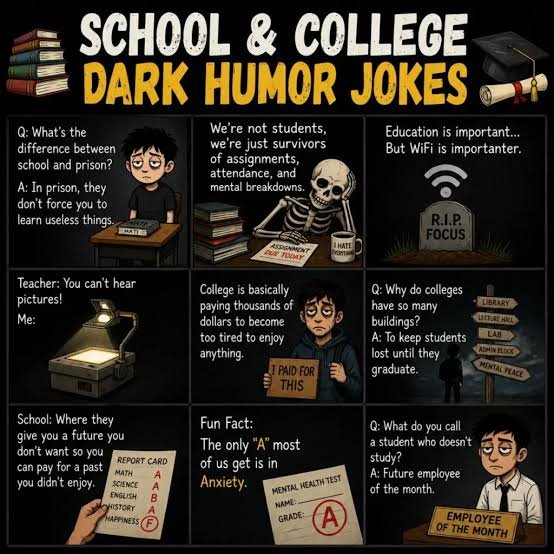
| Topic | Quick Information |
|---|---|
| Main Keyword | Dark humour jokes |
| Also Known As | Dark comedy, black humour, gallows humour |
| Main Theme | Comedy involving serious or uncomfortable subjects |
| Common Style | Irony, surprise, absurdity, satire |
| Historical Connection | Literature, theatre, satire, and comedy |
| Modern Popularity | Memes, stand-up comedy, films, and social media |
| Key Challenge | Humour depends heavily on context and audience |
| Original Angle | The same joke can feel funny or offensive |
What Are Dark Humour Jokes?
Dark humour jokes use comedy around uncomfortable subjects. These subjects may involve death, fear, tragedy, failure, or social taboos.
The goal is not always cruelty. Often, the humour comes from surprise. A serious situation suddenly receives an absurd interpretation.
Psychologists have studied why people laugh at uncomfortable material. The American Psychological Association notes that humour theories often involve surprise, tension, and the release of restrained thoughts.
Dark humour therefore works through contradiction. The subject feels serious. The response feels unexpectedly playful.
That emotional clash creates the joke.
Why Are Dark Humour Jokes Funny?
Dark humour often operates near a social boundary. Something feels wrong, surprising, or inappropriate.
However, the audience must also feel safe enough to laugh.
The Surprise Factor
Many jokes depend on broken expectations. The listener predicts one ending. The comedian delivers another.
Dark humour can increase that surprise. Serious subjects already carry emotional weight. An unexpected punchline changes the direction instantly.
Humour researchers have explored theories based on incongruity and violated expectations. The American Psychological Association also discusses the idea that humour can emerge when a violation feels harmless enough to enjoy.
Tension Can Create Comedy
Dark topics naturally create tension. A joke can briefly release that tension.
This does not mean every dark joke helps everyone. People react differently based on experience, culture, personality, and timing.
The same joke may produce laughter in one group. Another audience may find it insensitive.
That difference is central to dark comedy.
Dark Humour Is Not the Same as Being Cruel
A common misunderstanding surrounds dark humour jokes. People sometimes assume dark comedy always means mocking suffering.
That is not necessarily true.
Some dark jokes target fear itself. Others mock social systems, hypocrisy, absurd situations, or human behaviour.
For example, satire may use uncomfortable subjects to expose contradictions. Irony may highlight how strange real life can become.
The target of the joke matters greatly.
A Useful Difference
Dark humour often works better when:
- The joke has a clear comedic idea.
- The punchline creates genuine surprise.
- The context supports the humour.
- The joke does not simply attack vulnerable people.
- The audience understands the intended tone.
A joke can be dark without being lazy. Shock alone does not automatically create good comedy.
The Psychology Behind Dark Humour Jokes
Humour is a complicated psychological process. Researchers continue to study why different people prefer different comic styles.
One study published in Scientific Reports explored differences between bright and dark humour. The research suggested that different humour styles involve distinct psychological and cognitive patterns.
More recent research also shows that humour styles should not all be treated identically. Studies examining light and dark humour have found different relationships between specific comic styles and emotional experiences.
This is important because enjoying dark humour does not automatically reveal someone’s personality.
A person may enjoy one dark joke. They may dislike another.
Humour preference remains highly individual.
Why Dark Humour Often Appears During Difficult Times
Humour can become a coping tool during stressful periods.
People have historically used jokes in difficult environments. This includes workplaces, hospitals, military settings, and other high-pressure situations.
The reason may seem strange initially. Serious circumstances and comedy appear opposite.
Yet humour can help people discuss difficult experiences indirectly.
Research reported by the American Psychological Association found that humorous content could influence positive emotions and stress responses during the COVID-19 pandemic.
However, dark humour should not be described as a universal treatment. A joke may help one person cope while upsetting another.
Context always matters.
Dark Humour Jokes in Movies, Literature, and Online Culture
Dark comedy existed long before social media.
Writers and performers have long mixed tragedy with comedy. This combination can make serious stories feel more complex.
Modern audiences now encounter dark humour through:
- Stand-up comedy.
- Television shows.
- Films.
- Internet memes.
- Satirical websites.
- Social media posts.
Online culture has also changed how quickly jokes spread. A dark joke can move across countries within hours.
However, online audiences lack shared context.
A joke intended for close friends may reach strangers. Those strangers may interpret it completely differently.
This makes modern dark humour more complicated.
When Does Dark Humour Cross the Line?
There is no single universal answer.
Comedy depends on culture and personal experience. Timing also matters enormously.
A joke about a past event may receive one reaction. The same joke immediately after a tragedy may receive another.
The difference often comes from emotional distance.
Questions Worth Considering Before Sharing
Before posting dark humour jokes, consider:
- Who is the audience?
- What is the joke actually targeting?
- Could the context change its meaning?
- Is the humour clever or simply shocking?
- Could someone directly affected see it?
These questions do not eliminate comedy. They simply encourage better judgment.
Strong comedy often understands its audience.
A Simple Look at Different Dark Humour Styles
| Style | How It Usually Works | Main Effect |
|---|---|---|
| Gallows Humour | Joking during frightening situations | Releases tension |
| Satire | Uses humour against social problems | Encourages reflection |
| Irony | Creates contrast between expectation and reality | Produces surprise |
| Absurd Humour | Pushes situations into ridiculous extremes | Creates confusion and laughter |
| Black Comedy | Mixes serious themes with comedy | Creates emotional contradiction |
Academic discussion has also separated dark humour into different forms, including taboo-breaking, disparaging, and sarcastic approaches.
This shows why the phrase dark humour jokes covers many different styles.
Why Some People Love Dark Humour and Others Hate It
Dark humour requires a specific emotional balance.
The joke must feel uncomfortable enough to surprise. Yet it must feel safe enough to amuse.
If the material feels too harmless, the joke may seem boring. If it feels too painful, laughter may disappear.
Research on taboo language also suggests that taboo-related material can produce strong emotional responses, while perceived humour varies alongside those reactions.
This explains why audience reaction can be unpredictable.
Comedy is not mathematics.
There is no joke that guarantees laughter.
The Real Appeal of Dark Humour Jokes
The strongest dark humour does more than shock.
It can reveal contradictions in society. It can expose uncomfortable truths. It can also show how people use laughter against fear.
That makes dark comedy culturally interesting.
The joke creates distance from something difficult. For a brief moment, the audience views the subject differently.
However, that distance has limits.
Good dark humour understands those limits. Poor dark humour often ignores them.
Final Thoughts
Dark humour jokes remain popular because they challenge normal expectations. They mix discomfort with surprise and seriousness with absurdity.
Their meaning changes with the audience.
What feels clever to one person may feel offensive to another. That does not make humour simple or predictable.
It makes humour human.
The best dark comedy usually offers more than shock. It creates an unexpected perspective and gives the audience something to think about after the laughter ends.
Frequently Asked Questions
What are dark humour jokes?
Dark humour jokes use comedy around serious or uncomfortable subjects. These subjects may include death, fear, tragedy, or social taboos. The humour usually comes from surprise, irony, or absurdity rather than the serious event itself. Different people have different boundaries. Therefore, a joke that works for one audience may fail with another. Context, timing, and the target of the joke strongly affect how people respond.
Why do people enjoy dark humour jokes?
People may enjoy dark humour because it creates an unexpected emotional contrast. A serious subject suddenly receives an absurd or ironic response. That surprise can create laughter. Some people also use humour to discuss uncomfortable experiences indirectly. Research on humour suggests that surprise, tension, and emotional release can all contribute to amusement. However, enjoyment varies greatly between individuals and cultures.
Is dark humour the same as offensive humour?
No. Dark humour and offensive humour can overlap, but they are not identical. Dark comedy may explore difficult subjects without directly attacking people. Offensive humour may focus more heavily on insult, hostility, or deliberate provocation. The difference often depends on context and the joke’s target. A thoughtful dark joke may explore fear or absurdity. A harmful joke may simply use shock without offering a meaningful comedic idea.
Can dark humour help people deal with stress?
Humour can sometimes help people manage stressful experiences. Research discussed by the American Psychological Association found that humorous content could support positive emotions and coping during stressful periods. However, humour is not a universal solution. Dark humour may comfort some people and upset others. Personal experiences strongly influence reactions. It should therefore never be assumed that a dark joke will help everyone facing a difficult situation.
Why does timing matter in dark humour?
Timing changes how audiences understand a joke. People may react strongly when a painful event feels recent or personally relevant. Greater emotional distance can sometimes change that reaction. Cultural background also affects acceptable timing. A comedian, writer, or social media user should consider the audience before sharing sensitive humour. A joke does not exist separately from its context. The same words can feel very different depending on when and where people hear them.
Read more:Kurt Hummel: The Glee Character Who Turned Difference Into Strength
